
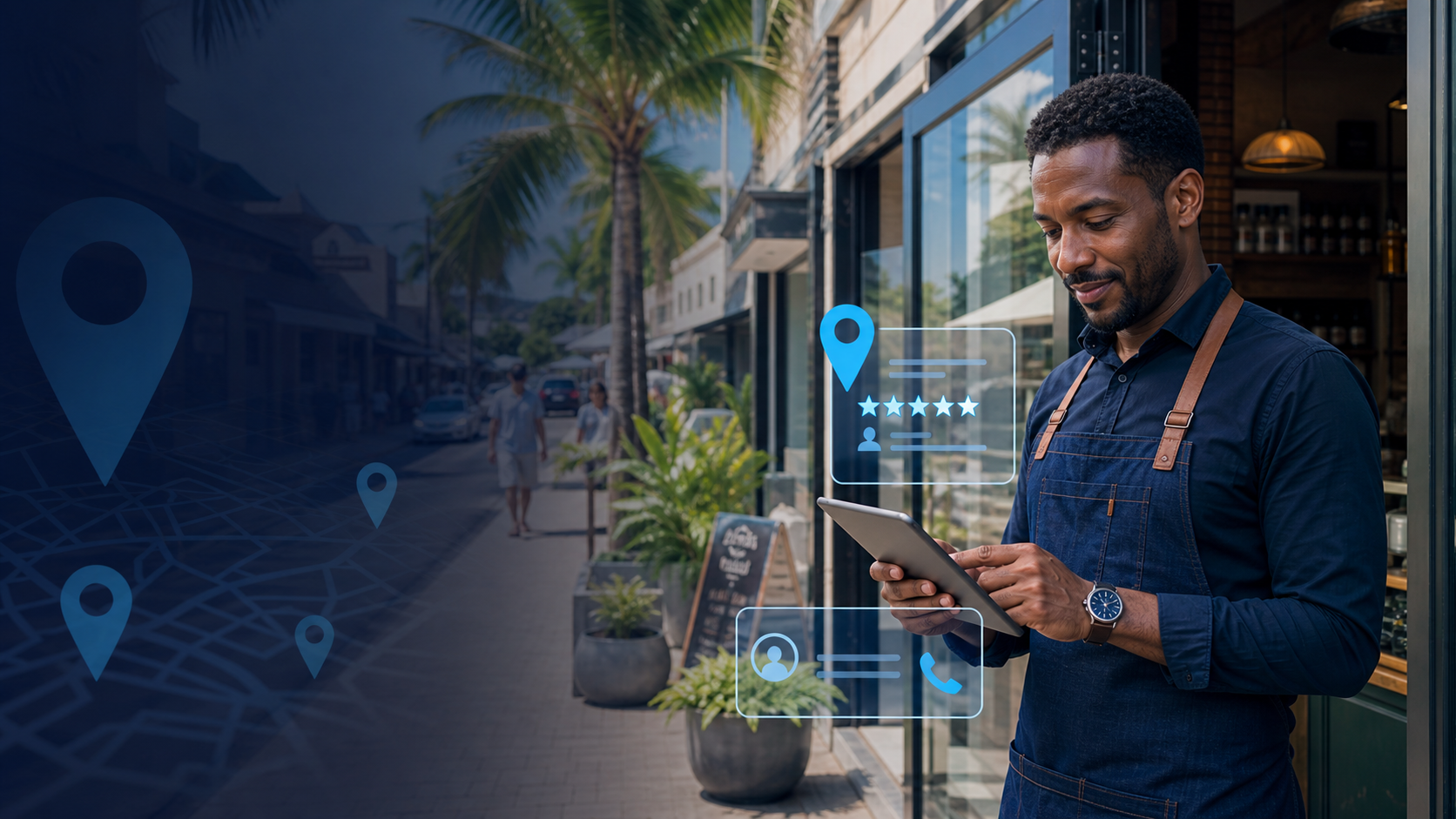
When someone searches for a service near them, Google doesn’t just show websites — it shows a map with a short list of local businesses. That list, called the local pack, appears at the top of results above the organic links. It gets a disproportionate share of clicks.
Most business owners want to be in it. Fewer understand what actually determines who shows up.
The three factors Google uses
Google is relatively transparent about this. Local rankings are determined by three things: relevance, distance, and prominence.
Relevance is how well your business matches what the searcher is looking for. A restaurant that lists itself only as “food” is less relevant to a “Caribbean restaurant” search than one that specifically describes its cuisine, menu, and dining experience. The more precisely Google understands what you do, the more often it will serve you for the right searches.
Distance is how far your business is from the searcher (or the location they specified). You can’t move your business to improve this — but you can define your service area accurately, which helps for searches across a broader radius.
Prominence is a measure of how well-known and trusted your business is, based on information across the web. This includes your review quantity and rating, how consistently your name and address appear across other sites and directories, links to your website, and how much engagement your Google Business Profile gets.
Of the three, prominence is the most actionable — and the most neglected.
What you can actually do
Complete your Google Business Profile
A half-filled profile sends a weak signal to Google and a weak impression to the customer looking at it. Complete every section: business category (primary and secondary), description, hours, photos, services, service area, website link, and attributes. The more information Google has, the more confidently it can serve your listing for relevant searches.
Photos matter more than most businesses realize. Profiles with photos get significantly more direction requests and website clicks than those without. Add real photos of your location, team, and work — not stock images.
Build your review volume
Reviews affect ranking directly. Google wants to send searchers to businesses that other customers have validated. The number of reviews, the average rating, and how recently reviews were left all factor in.
The most effective way to build reviews is to make asking a consistent part of your process — a text message or email sent after a job is complete, with a direct link to your Google review form. Make it one tap for the customer.
Respond to every review. A thoughtful response to a negative review often matters more to a prospective customer than the review itself. It signals that the business pays attention and takes feedback seriously.
Build local citations
A “citation” is any online mention of your business name, address, and phone number. Google uses citation consistency as a trust signal — if your information matches across Google, Yelp, Facebook, TripAdvisor, and relevant local directories, Google becomes more confident in the accuracy of your listing.
Inconsistencies (different phone numbers, old addresses, misspelled names) dilute that signal. An audit and cleanup of your citations is one of the most straightforward improvements you can make.
Think about your service area
If your business travels to customers rather than having them come to you, defining your service area in Google Business Profile helps you appear in searches across the area you serve — not just right around your address. For businesses in Saint Lucia, this might mean covering all of the island. For an Austin contractor, it might mean specific zip codes or suburbs.
Use your profile actively
Businesses that post updates, respond to questions, and keep their hours current tend to outperform static profiles over time. Google treats an active profile as a signal that the business is open and engaged. A monthly post with a photo and a brief update is enough to maintain that signal.
The role your website plays
Your Google Business Profile and your website are connected. A well-optimized website — one that mentions your location, services, and the specific terms your customers search for — reinforces your relevance for local searches and contributes to your organic ranking below the map.
This is why local SEO and Google Maps optimization are treated as a single strategy rather than separate channels. The profile drives the map placement; the website supports both organic ranking and gives the customer somewhere credible to land once they click.
What not to do
A few things that don’t work and can actively hurt your ranking:
- Keyword stuffing your business name. Adding keywords like “Best Plumber Austin TX” to your business name field violates Google’s guidelines and can get your listing suspended.
- Buying fake reviews. Google detects patterns and removes them. The penalty isn’t worth it, and fake reviews don’t convert real customers anyway.
- Leaving your profile unclaimed or incomplete. An unclaimed profile is one a competitor or spammer can request to manage. Claim it, complete it, and keep it updated.
Where to start
Pull up your business on Google Maps right now. Look at it the way a new customer would. Is the information accurate and complete? Are there photos? When was the last review posted?
If the answers reveal gaps, those gaps are ranking opportunities. A well-maintained profile in a market where most competitors have neglected theirs is often all it takes to move into the local pack.
If you want a proper audit of your local presence — your profile, citations, and how you compare to competitors in your area — reach out for a free review. We’ll tell you exactly where you stand and what to prioritize.